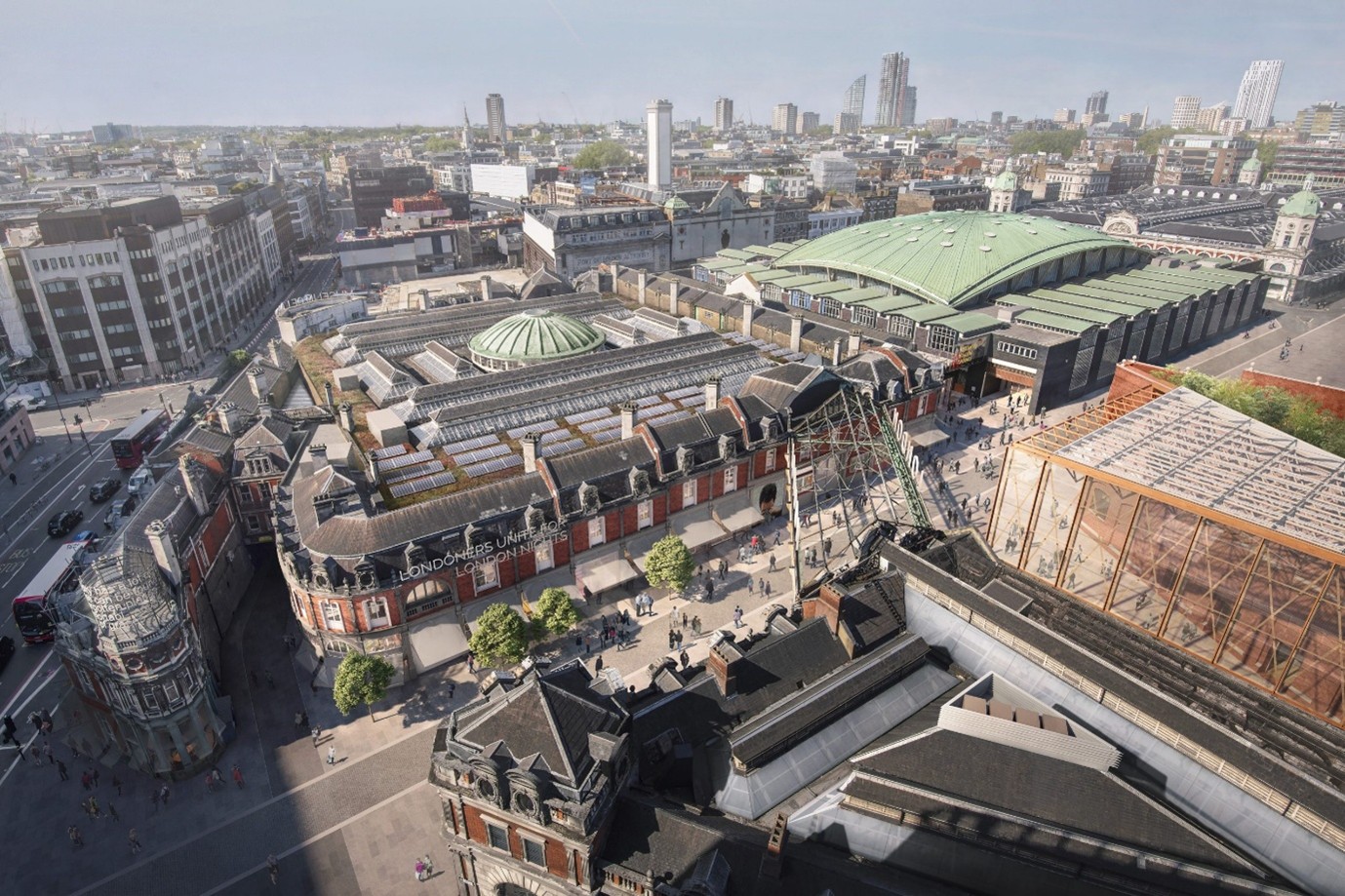
Image credits: London Museum Planning Image @ Secchi Smith
London, 10 November 2025: London Treasury is delighted to announce the latest investments from the Mayor’s Green Finance Fund (GFF), which is supporting two landmark sustainability projects in the capital.
A loan of up to £20 million will help deliver energy-efficient, low-carbon infrastructure at the new London Museum, located in two of Smithfield’s historic market buildings. Spanning 27,000 square metres across the former General Market and adjacent Poultry Market, the redevelopment blends heritage conservation with cutting-edge sustainability. Once complete, the museum is expected to double attendance figures to over two million visitors each year. The project is expected to create approximately 1,500 full-time jobs and generate £565 million in Gross Value Added (GVA) over its first decade.
Key environmental features include natural ventilation, high-efficiency heating and cooling systems, rooftop solar panels, underground water capture and reuse tanks, and smart energy controls. Together, these sustainable enhancements are expected to reduce Greenhouse Gas (GHG) emissions by 1,771 tonnes of CO₂ annually, equivalent to taking 1,229 cars off London’s roads1.
In a second major commitment, the GFF is deploying up to £58 million to the Royal Borough of Kensington and Chelsea (RBKC) for a deep retrofit of 367 social homes across three blocks on the Lancaster West Estate in North Kensington. This work forms part of a wider £244 million resident-led refurbishment following the Grenfell tragedy.
The Council’s whole-house, fabric-first approach includes triple-glazed windows, advanced insulation, mechanical ventilation with heat recovery, smart heating controls, low-energy lighting, and a full transition from gas boilers to communal air source heat pumps. These safe and sustainable upgrades are expected to reduce 903 tonnes of CO₂ emissions annually, equivalent to taking 627 cars off the road.
Mete Coban MBE, Deputy Mayor for Environment and Energy, said:
“The Green Finance Fund was created to help London reach our net zero ambitions and these landmark projects at London Museum and Lancaster West Estate are the next part of more than £300 million of green investment across the capital.
The Mayor’s fund has already supported 11 major projects spanning energy efficiency, renewable energy and clean transportation. The Mayor and I want all Londoners – regardless of where they live – to benefit from a healthier and more climate resilient city. I am proud of the real impact that this fund and our wider investments have made as we continue to build a fairer, greener, and healthier London for everyone.”
Sharon Ament, Director at London Museum, said:
“We are forging ahead to make London Museum a world leader for sustainability in the culture sector. Whether it’s powering our toilets with rainwater, optimising our energy use through smart systems, or leaning into the market’s structure to naturally ventilate the building, we want to be part of creating positive change for London and for future generations. Support like this is a huge vote of confidence and absolutely critical in helping us get there.”
Cllr Elizabeth Campbell, leader of Kensington and Chelsea Council, said:
“The support we’ve received from the GLA Green Finance Fund will enable us to carry out this vital work and make a real difference in our residents’ lives. The terms of the loan are beneficial to the Council and our residents as the money saved will be reinvested into our homes and communities.”
Kenroy Quellennec-Reid, Deputy Director – Impact Investment at London Treasury, said:
“We’re proud that investment from the Green Finance Fund is supporting two transformative projects that advance London’s sustainability and inclusivity goals. The development of a new, environmentally responsible home for the museum—featuring smart building technologies, energy-efficient lighting, and renewable energy—will create a cultural destination fit for the 21st century. At the same time, our partnership with the Royal Borough of Kensington and Chelsea to retrofit 367 homes on the Lancaster West Estate reflects a deep commitment to delivering safer, greener housing for Londoners.”
The GFF offers uniquely flexible loans with low interest rates, agreed on a project-by-project basis. It was launched in 2023 and will lend up to £500 million to projects that help London meet its net zero ambitions. The focus is to accelerate decarbonisation by lowering the cost of borrowing for eligible organisations.
As of September 2025, the GFF has allocated £346.8 million to fifteen projects. In addition to the support provided to London Museum and RBKC, the GFF has provided finance for the installation of an innovative solar membrane on the London Stadium, supported the London Borough of Barnet’s corporate estate retrofit programme across 19 sites, incorporating 17 schools, and supported the iconic Crystal Palace National Sports Centre go all-electric as part of the redevelopment of the historic site. The fifteen approved projects to date are expected to reduce GHG by 38,935 tCO2e per annum, equivalent to taking 27,022 cars off the road and delivering energy savings of 51,161 MWh per annum, equivalent to the energy needed to heat 5,112 homes per year2.
End notes:
1 Cars taken off the road – based on an average annual car mileage of 5,373 miles. Source: Department for Transport, National Travel Survey: England 2022 Main Results, August 2023.
2 Energy saved – based on the average household consumption of 11,500kWh per annum for a two to three-bedroom house. Source: Ofgem. Accessed from: Average gas and electricity usage | Ofgem.